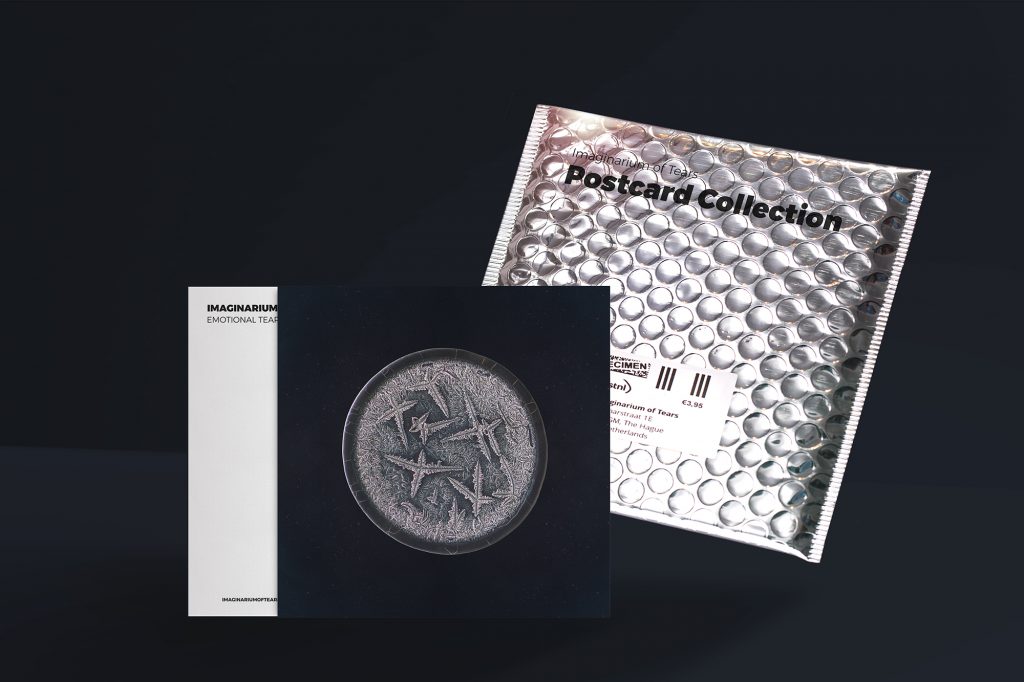
Postcard Collection
€ 30.00
10 real human tears from 10 different people, photographed under the microscope.
This collection of microscopy art postcards from Imaginarium of Tears reveals the unique microscopic landscapes of the three types of human tears: emotional, reflex and basal tears.
Each postcard transforms one person’s tear into an individual microscopic artwork, connecting science, photography and human stories.
- 10 people · 10 unique tear artworks
- 3 types of human tears
- 135 × 135 mm square postcards
- Full colour on 330 g/m² paper
- Matte-laminated front
- Presented in a silver envelope
Human Tears Under the Microscope
A collection of 10 art postcards revealing the hidden microscopic landscapes of real human tears.
Each postcard features a unique human tear collected from a different person and photographed under the microscope as part of Imaginarium of Tears, an ongoing art and science project by Maurice Mikkers.
This microscopy art postcard collection brings together the three types of human tears: emotional tears, reflex tears and basal tears. Under the microscope, every sample reveals its own intricate structures, patterns and crystal-like landscapes.
These microscopic tear photographs transform something temporary and almost invisible into a lasting visual record. Each image is connected to a real person, a specific tear and the circumstances in which that tear was collected.
On the reverse of every postcard you will find the name of the artwork and the type of tear shown.
The Collection
The set contains:
- 10 different microscopic tear artworks from 10 different people
- Examples of emotional, reflex and basal tears
- 10 square art postcards measuring 135 × 135 mm
- Printed in full colour on 330 g/m² paper
- Matte-laminated artwork on the front
- Artwork name and tear type printed on the reverse
- Presented together in a silver envelope
Tears Under the Microscope
Human tears consist largely of water, salts, proteins, lipids and other biological components. When a tear sample dries on a microscope slide, these components can form complex microscopic structures.
The resulting patterns vary from tear to tear. Factors such as the individual sample, drying process and surrounding conditions influence the structures that eventually become visible.
Through microscopy and photography, these temporary traces can be preserved as detailed visual landscapes.
Emotional, Reflex and Basal Tears
The human eye produces different types of tears for different purposes.
Emotional tears are associated with strong emotional experiences such as sadness, happiness, frustration or relief.
Reflex tears are produced when the eye responds to external stimulation, such as wind, smoke, dust or cutting an onion.
Basal tears are continuously present on the surface of the eye, helping to lubricate, protect and nourish it.
The Imaginarium of Tears collection brings these different tear types together, allowing their microscopic structures to be explored side by side.
Where Science, Photography and Art Meet
Imaginarium of Tears explores what becomes visible when something as familiar and fleeting as a human tear is examined through a microscope.
A tear may exist only briefly, but its microscopic traces can form extraordinary patterns. By collecting, preparing and photographing these samples, Maurice Mikkers creates images at the intersection of scientific imaging, microscopy photography and visual art.
The project connects the biological material of the tear with the individual story behind it, creating a visual archive of human experiences and microscopic structures.
A Science and Art Gift
The postcard collection is designed for people interested in microscopy, scientific photography, science art, biology, scientific visualization and art.
The cards can be kept together as a complete collection, displayed individually, framed as small artworks, sent as postcards or given as an unusual science-art gift.
Each set offers a compact introduction to the visual world of Imaginarium of Tears and to the hidden structures that can be found inside something as ordinary as a single human tear.
10 people. 3 types of tears. 10 microscopic landscapes. One collection revealing a world normally invisible to the human eye.